
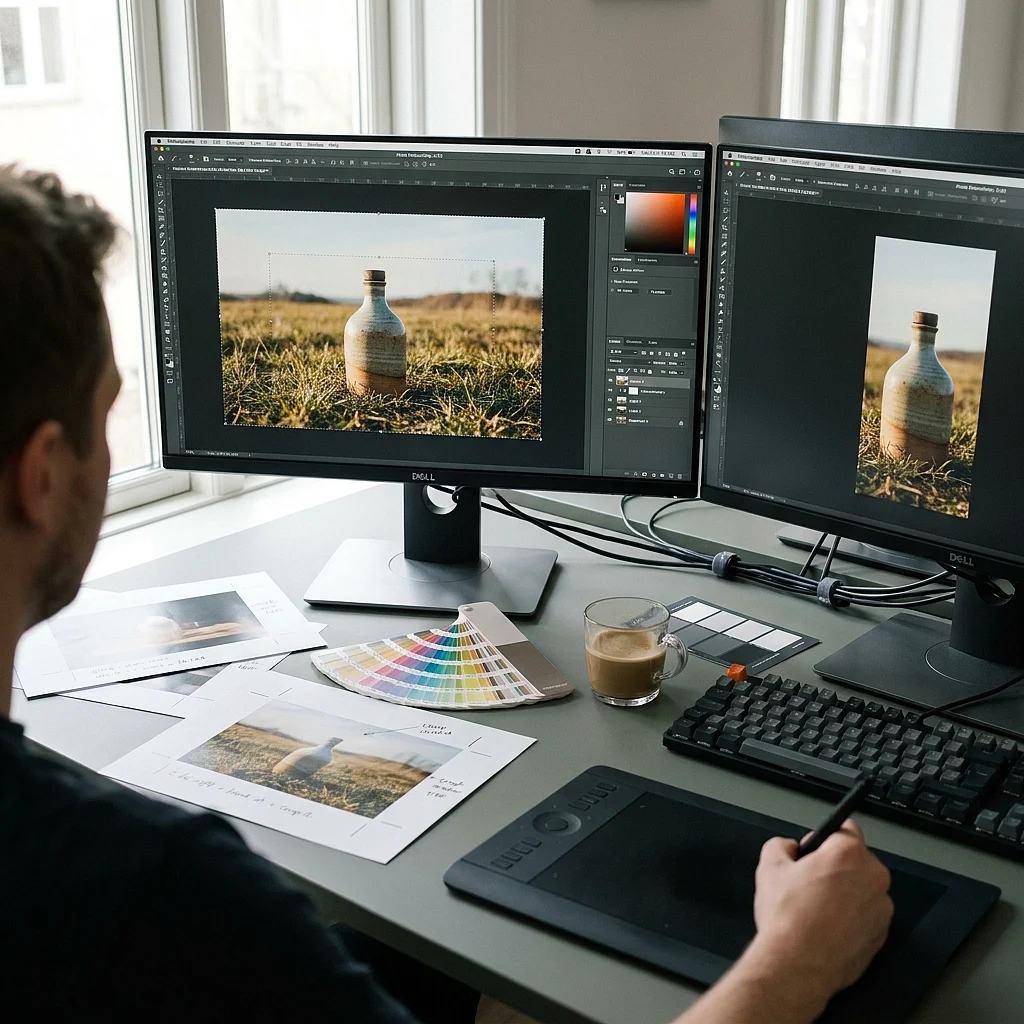
Adobe is integrating a new AI assistant into Photoshop. The AI Assisted Editor is accompanied by two further tools: Markup and Instruct Edit are intended to make AI-supported edits more precisely controllable. This brings prompt-driven work — that is, image editing via formulated instructions rather than via tool palettes — further into the standard environment of many design teams.
The announcement does not provide more details, and no more should be read into it. What is interesting is the direction: not a separate AI tool alongside Photoshop, but an assistance layer within the program in which image material for websites is produced anyway.
Why the tool names already contain a statement
The names suggest different ways of controlling the process. Instruct Edit suggests an edit via a linguistic instruction, Markup an edit via a direct marking in the image. Together, both address the best-known weakness of generative image tools: a prompt describes an intention, but not necessarily the place in the image where it should take effect.
In practice, this means: the gap between "this is how I would like it" and the result becomes smaller. In web projects, precisely this gap has so far cost time — in correction loops, in follow-up questions, in cut-outs and retouches that nobody sees as a separate line item in the quote.
What changes in image production for websites
A website rarely needs one image. It needs a motif in several crops, in several aspect ratios, for teasers, hero areas, social previews and mobile display. On top of that come variants for campaigns, language versions and seasonal occasions.
This is exactly where the economic effect of rapid iteration lies. If variants become cheaper, more of them are created. That is good at first: images fit the crop better, text clearances sit correctly, motifs can be adapted to target groups. But it is also a volume problem that must be addressed elsewhere.
Brand consistency becomes the actual task
As long as image editing was time-consuming, the effort itself acted as a filter. Every motif passed through a few hands, and those hands knew the visual language. If variants are produced in minutes, this filter disappears — and with it a silent quality assurance.
Anyone who accelerates image production should therefore define in parallel what makes an image recognisably on-brand:
- Visual language: perspectives, framing, colour mood, degree of staging.
- Taboos: motifs, stylistic quotations and edits that do not fit the brand.
- Approval: who decides which generated motif is published.
- Origin: where the source material comes from, and how its use is regulated.
- Labelling: how it is documented internally that an image was edited with AI support.
These points are not bureaucracy, but the prerequisite for speed to be usable at all. Without them, an image stock emerges in which nobody can say any longer which file is the valid one.
The handover point between design and editorial
In many projects, design work does not end with the handover of the templates. Editorial teams maintain content themselves, upload images, swap motifs. If image editing becomes easier, this boundary shifts further towards editorial.
For content management systems such as TYPO3, this is less a technical than an organisational question. The systems have long been able to generate image variants automatically: one original image, defined image crops per purpose, sizes and formats derived from them. This mechanism remains valuable — especially when more motifs are in circulation.
A clear division therefore makes sense: the creative editing of a motif belongs in the image program, the technical preparation for output channels in the CMS. If the two are mixed, dozens of manually cropped files emerge that have to be touched again with every redesign.
What decision-makers can sensibly review now
It is too early for restructuring projects based on an announcement. But it is a good time for stocktaking:
- How many working hours currently go into image preparation, and which steps take the most time?
- Does a documented visual language exist, or does it live in the experiential knowledge of individuals?
- Are image crops maintained in the CMS or fixed in individual files?
- How is it regulated which image editing tools may be used with client data and images of people?
Anyone who can answer these four questions benefits from faster tools immediately. Anyone who cannot will above all produce more material.
Assessment
For web and software projects, the bottleneck is shifting: in future, the scarce resource will not be the creation of image material, but selection, approval and clean management. Projects should therefore invest less in individual image files and more in robust image concepts, defined crops and automated delivery in the CMS. Tools such as an AI assistant in Photoshop unfold their benefit where the editorial rules behind them already exist.


