
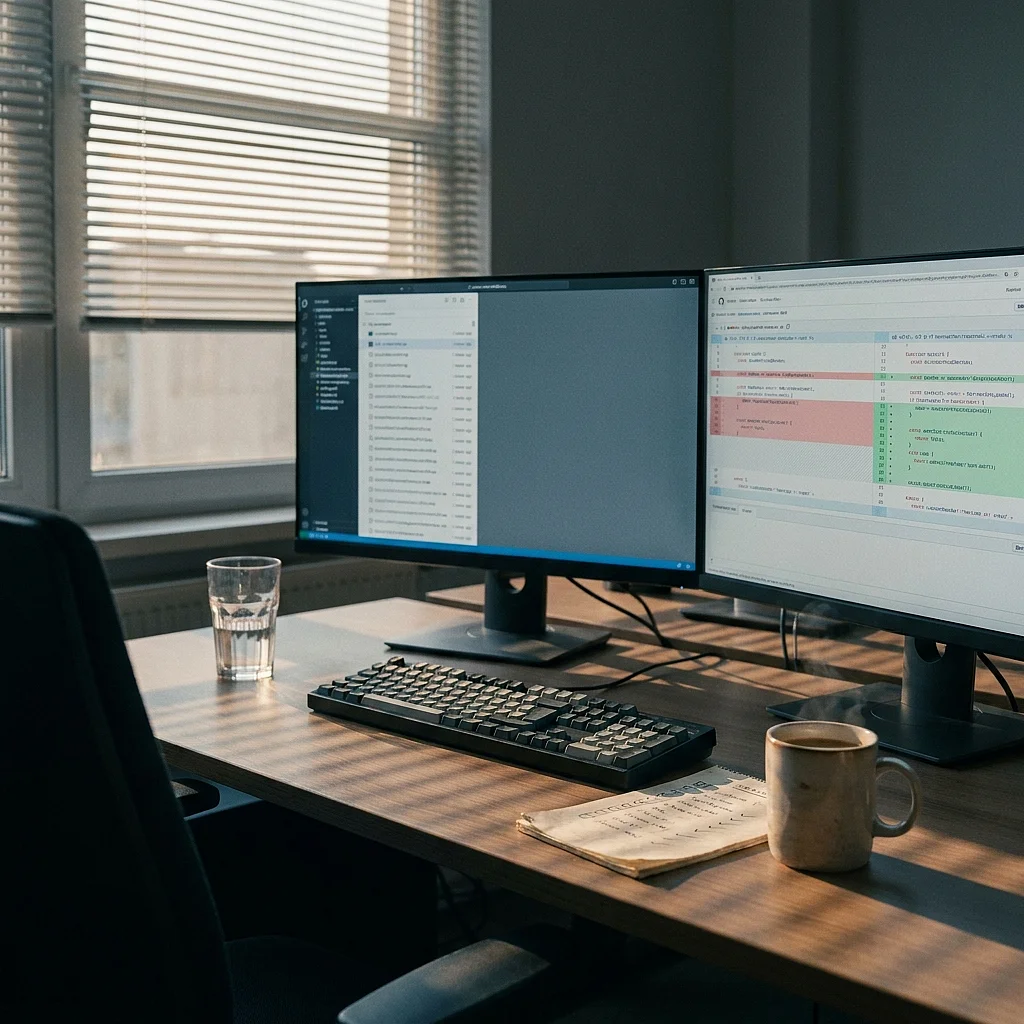
Anthropic has internally tested what happens when an AI agent is not called in for ad-hoc assistance, but permanently takes over the daily maintenance of a codebase.Claude Code, the company's agentic command-line tool, works on its own apps: triggered via Slack command, with tasks ranging from crash fuzzing to dead-code removal.
Crash fuzzing refers to automatically feeding an application with unexpected inputs in order to provoke crashes and thereby find bugs.Dead-code removal means removing program code that is no longer called and only makes maintenance harder.Both are tasks that often get left undone in practice because they deliver no feature and make no customer visibly happy.
The numbers: 388 pull requests, just under half adopted
Within a few weeks, the agent created 388 pull requests – that is, change proposals that are reviewed before being merged into the main codebase.46 percent of them were adopted after human review.Boris Cherny, the creator of Claude Code, speaks of an "early sign of life" for autonomous software maintenance.
This wording is remarkably restrained, and it matches the numbers.An adoption rate of 46 percent means, conversely: more than half of the proposals were not good enough, not relevant or wrong.Anyone who reads this figure as a disappointment is applying the wrong yardstick.What matters is not whether an agent works flawlessly, but whether the effort of reviewing and discarding is smaller than the benefit of the adopted changes.
That is precisely the real message of the experiment: an AI agent that continuously proposes maintenance work without additional personnel costs shifts the cost-benefit calculation.Tasks for which nobody wanted to carve out half a day beforehand suddenly become workable – as long as someone reviews the results.
The counterpoint: study sees autonomous research as a distant prospect
On the same day, a study became known that clearly contradicts the autonomy expectations of Anthropic and OpenAI.AI agents based on Claude Opus 4.8 and GPT-5.6 Sol were given six days, a budget of 3,000 dollars and access to GPUs to independently write AI research papers.The results were evaluated by the original authors of unpublished NeurIPS papers – the conference regarded as one of the most important venues in the field.The verdict: "Reject".
Princeton and the UK AI Security Institute, among others, were involved in the study.Their finding is more nuanced than the overall verdict suggests: the frontier models master the complete research engineering, that is, the hands-on implementation – writing code, setting up experiments, evaluating results.They fail at three other things: at research judgement, that is, assessing which question is even worthwhile; at creative problem-solving; and at the ability to abandon failed approaches and choose a new path.
Both findings complement each other
At first glance, the two reports contradict each other.In fact, they describe the same boundary line from two sides.Where the task is clearly defined, a success criterion exists and the implementation is hands-on, agents deliver usable results – crash fuzzing and dead-code removal are exactly such tasks.Where judgement is required, where it must be decided what is important and when an approach should be abandoned, humans remain indispensable.
For software maintenance, a workable division of labour can be derived from this:
- Well suited to agents: tasks with a machine-verifiable result – increasing test coverage, removing dead code paths, updating outdated dependencies, detecting recurring error patterns.
- Still human: architecture decisions, prioritisation, the question of whether a problem should be solved at all, and recognising when a chosen path is not working.
- The bottleneck: review capacity.With an adoption rate below 50 percent, review effort arises that must be planned for.
What this means for project organisation
Anyone who integrates agents into maintenance shifts work – they do not make it disappear."Writing code" becomes "evaluating change proposals".For many teams this is the more pleasant activity, but it demands discipline: without binding review rules, automated tests and a clear definition of what an agent may merge itself and what it may not, a backlog of unreviewed pull requests quickly builds up.
The access route via Slack is also noteworthy.It is not the model alone that makes the difference, but the embedding in existing workflows: the agent sits where the team communicates anyway and is triggered from ongoing operations.
A note on classification: Anthropic is reporting here on the use of its own product on its own code.The conditions are more favourable than in an average customer project – familiar codebase, high test coverage, experienced reviewers.The numbers are a signal, not a transferable benchmark.
For web and software projects, this means: autonomous maintenance agents are today a realistic way to reduce technical debt that would otherwise be left undone – provided that test coverage and the review process are robust.The benefit arises not from omitting human review, but from the fact that reviewing costs less time than writing it yourself.
And the decision about which tasks are tackled at all remains a human one for the time being.


