
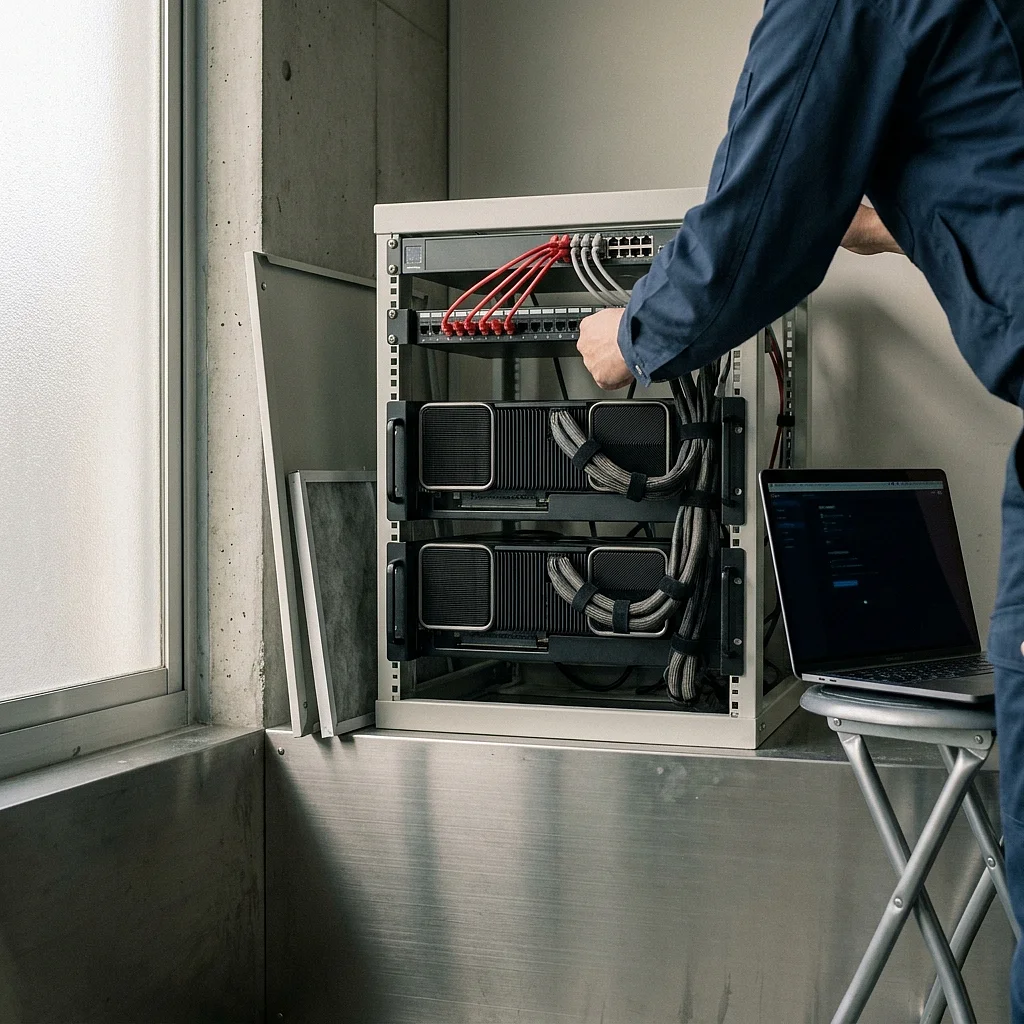
Deepseek has released a new multimodal model with V4.1-Flash, meaning a model that processes not only text but also other input forms.What is remarkable is less the size than the efficiency: the memory requirement in the so-called KV cache drops to a quarter of that of the predecessor model.At the same time, the model is available under the MIT licence, one of the most permissive open-source licences of all.
What the KV cache has to do with costs
The KV cache is the buffer in which a language model holds the already processed parts of a dialogue or a document so that it does not have to recalculate them for every new token.It grows with the length of the context – and that is precisely the problem with agents.
An AI agent in software development does not work with a single question but goes through many steps: read the repository, run tests, interpret error messages, write a patch, test again.In the process, it carries a long history with it.The KV cache resides in fast graphics memory, and this memory is the most expensive resource in operation.Anyone who quarters the requirement can serve more parallel agent runs on the same hardware or allow longer contexts without upgrading.
552 billion parameters, 16 billion active
According to Deepseek, the model comprises 552 billion parameters, but only around 16 billion of them are active per generated token.This design principle – only part of the network is used for each individual computation – keeps the computational effort per response low, even though the overall model is very large.In practice, this means: high requirements for available memory, but comparatively moderate requirements for computing power per request.
On the DeepSWE coding benchmark, according to the published figures, V4.1-Flash is just ahead of Opus 5 and GPT-5.6 Sol.Such benchmark leads are naturally narrow and say little about behaviour in a grown codebase.What is interesting here above all is the ratio: comparable results with significantly lower resource use.
MIT licence changes the options
The MIT licence permits commercial use, modification and redistribution with minimal conditions.Together with the reduced memory requirement, this creates an option that previously existed for many companies only on paper: the operation of a powerful coding model in their own infrastructure or at a host of their own choosing.
This is not a purely technical detail.Anyone who operates a model themselves shifts the question of which code parts leave the house from the contractual level to the network level.For projects with commissioned data processing, industry requirements or internal security policies, this is often the decisive point – regardless of how well a commercial API model performs in terms of content.
What this means for agent workflows
In projects, agent workflows rarely fail because of model quality but because of the bill behind them.An agent that processes a ticket independently consumes a multiple of the tokens of a simple chat dialogue because it iterates, checks intermediate results and reloads context.If the costs per run fall, the sensible fields of application shift:
- Migration work: recurring adjustments across many files, for example during a version jump or an API change
- Test coverage: generating and updating tests for existing modules
- Code review preliminary stage: automated review of changes before a human looks at them
- Documentation: deriving technical documentation from the actual state of the codebase
All these tasks are elaborate but easy to verify – the results can be run against tests, linters and review.This is exactly where an inexpensive agent pays off first.
What remains open
An open model is not yet a finished platform.Anyone who hosts it themselves takes on operation, monitoring, updates and capacity planning.With a model of this magnitude, the memory requirement remains considerable despite all optimisation, and the hardware must be procured or rented.Whether self-hosting pays off therefore depends heavily on utilisation: anyone who makes sporadic requests is still cheaper with an API.Anyone who runs agents continuously does the maths differently.
It is equally open how benchmark figures translate into concrete project quality.DeepSWE measures the processing of software tasks in defined scenarios.Legacy code with thin test coverage, idiosyncratic conventions and historical special cases is different terrain.The approach therefore remains the same: start small, measure on a delimited task type, hold results against existing verification mechanisms.
Assessment
The movement in the market is visibly shifting away from pure model size towards efficiency per task – and that is more relevant for project budgets than any new peak value.For web and software projects, this means concretely: agent support for migrations, tests and reviews is becoming a line item that can be budgeted realistically, and no longer an experiment with an open end.
Anyone planning here should design the architecture so that the model remains interchangeable, because the pricing and licensing situation is currently changing faster than your own codebase.


