
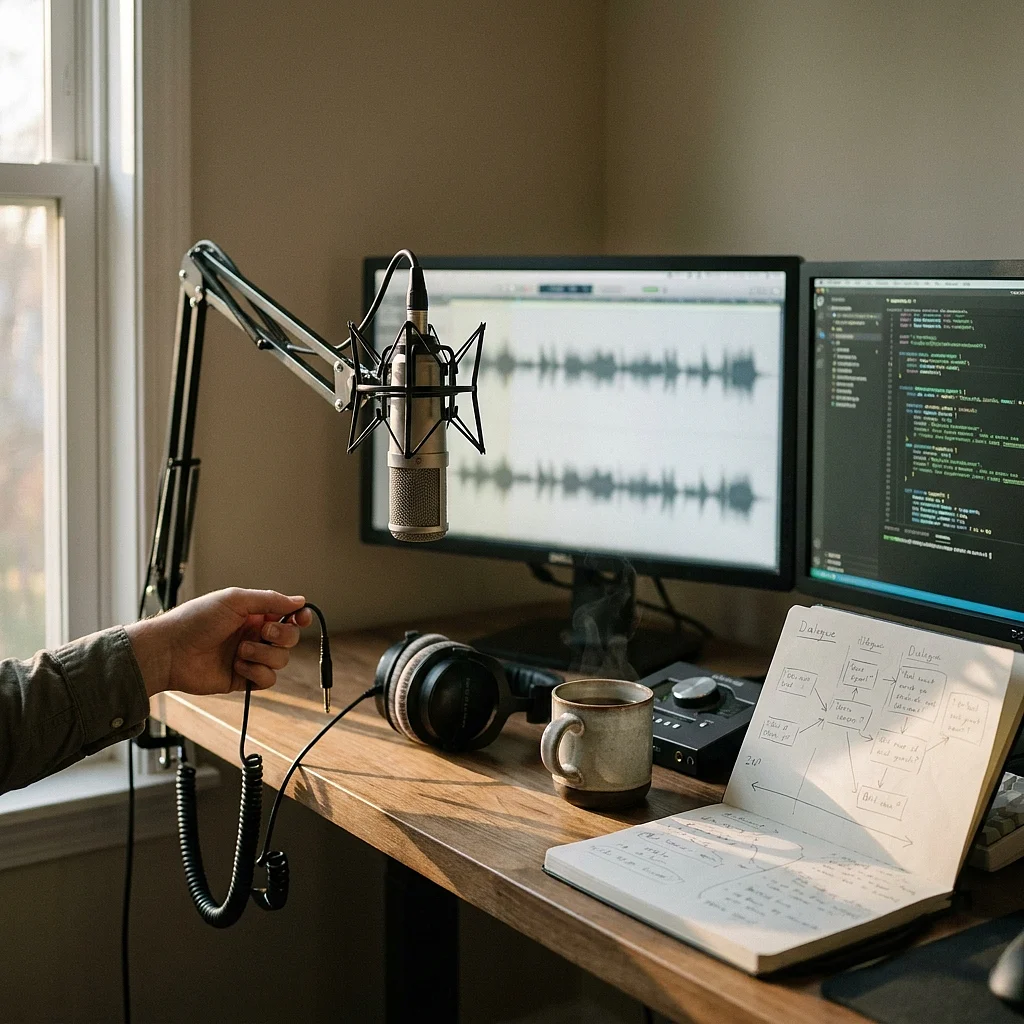
OpenAI has released GPT-Live-1 as an API for developers.The model is known from ChatGPT and operates in what is called full-duplex mode: it can listen and speak without the two directions blocking each other.Technically, this sounds like a detail, but in practice this very detail determines whether a voice dialogue feels natural or like a walkie-talkie.
What full duplex actually means
Classic voice assistants work in turns: the human speaks, the system detects the end of the utterance, processes, responds.Anyone who speaks in between disrupts the flow — either the interjection is ignored or it cancels the response completely.
Full duplex means that both channels are permanently open.The system registers interjections, follow-up questions and brief confirmations while it is still speaking itself, and can react to them.This gives the conversation a timing that comes closer to human turn-taking.
In benchmarks, OpenAI cites a lead of 30 percentage points over the previous model.From practice, there is a figure from the language learning app Speak: 80 percent fewer interruptions.Both figures come from the parties involved and should be assessed accordingly — but the direction is plausible, because precisely the interruption behaviour was the weak point of previous voice interfaces.
The cost side: 0.05 dollars per minute
The price is 0.05 dollars per conversation minute.That is not an amount that matters for individual dialogues, but it scales linearly with usage duration — and that fundamentally distinguishes voice APIs from text-based interfaces.
A calculation example as a guide, deliberately rough: a five-minute support dialogue costs around a quarter of a dollar in pure model usage.With a thousand such conversations per month, model costs arise in the low three-digit range.That is entirely justifiable for a support channel.For an open voice widget on a homepage that any visitor can use for any length of time, the calculation looks different — there the budget depends on a variable you can only control to a limited extent.
Add to that costs that are not on the price list: integration with existing systems, logging, testing effort and the operation of a real-time connection that is considerably more sensitive than an ordinary HTTP call.
Where voice control on the web actually works
Voice is not a better interface, but a different one.It wins where hands or eyes are occupied, where typing is cumbersome or where a process is inherently dialogic.
- Phone-related support: pre-qualification, status queries, appointment scheduling.Here voice does not replace an existing interface, but a hold queue.
- Mobile use on the go: order capture in field service, feedback from the construction site, warehouse queries with gloves on hands.
- Accessible access: voice control as an additional channel for user groups who find form operation difficult.
- Learning and training scenarios: practice dialogues in which natural interrupting is itself part of the task — the example of the language learning app points in this direction.
Voice is less convincing where structured input is required.An address, an item number or a date is not dictated faster than it is typed — and error correction in the voice channel is tedious.A voice interface placed in front of a form generally makes the process longer, not shorter.
Technical consequences for implementation
A full-duplex connection changes the architecture of a web application in several places.You need a persistent connection between browser and server, typically via WebSockets or WebRTC, and you need a server-side component that maintains this connection.Classic, stateless request-response patterns are not sufficient for this.
Three points that experience shows are underestimated in planning:
- Session limitation: Define early on how long a voice dialogue may run at most and what happens afterwards.Without hard limits, the cost risk cannot be calculated.
- Fallback to text: Every voice function needs an equivalent path without a microphone — for reasons of accessibility, because of noisy environments and in case the service is unavailable.
- Data protection and logging: Voice data is personal and often particularly sensitive.Clarify before implementation what is recorded, how long it is stored and how users are informed about it.
Assessment: prototype before expansion stage
The technical hurdle for natural-sounding voice dialogues has noticeably fallen with this API.That does not mean that every portal now needs voice control.The sensible order is: identify a concrete process in which voice shortens a real detour, build this process as a narrow prototype and check against real usage data how long a typical dialogue lasts and how often it leads to the goal.
Only from these figures does it emerge whether the per-minute costs are in proportion to the effort saved.This calculation turns out very differently depending on the use case — an automated callback in support has a completely different economic viability than a voice assistant on a product page.
What this means for web and software projects
Voice control is thus shifting from a question of feasibility to a question of architecture and cost.
Anyone planning it should have the connection logic, the session limiting and the text-based alternative in the concept from the outset instead of adding them on later. The most viable approach initially is clearly defined use cases with measurable benefit — general voice assistants on websites remain an expensive experiment with unclear returns.


