
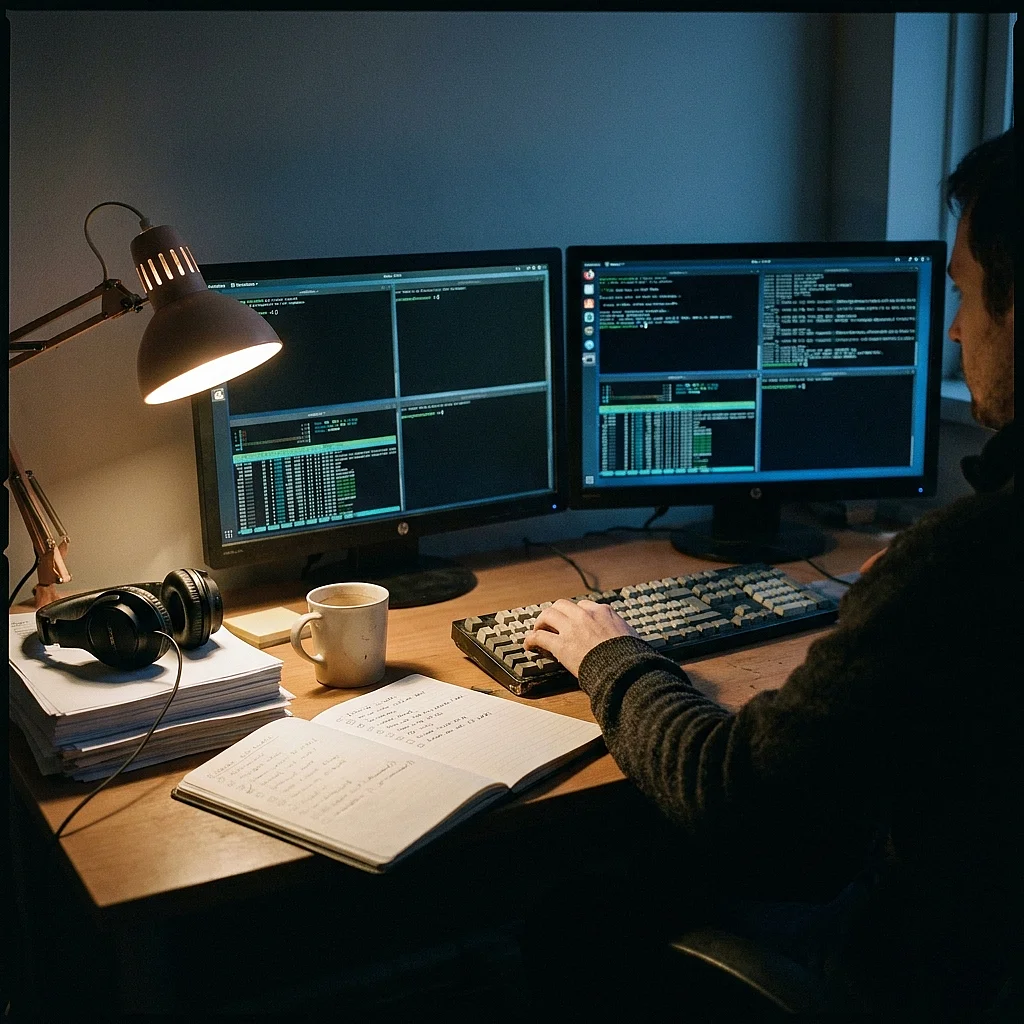
AI assistants that write, test and suggest changes to code independently rarely work in seconds. An agent preparing a refactoring across multiple files runs for minutes. The obvious reaction in development teams: don't wait, but put a second, third, fourth agent on other tasks. That is exactly where a new problem arises that has nothing to do with the quality of the models.
The bottleneck is not the model, but attention
Coding agents are not batch jobs that you dispatch and pick up later. They ask follow-up questions, request approvals for write access, report failed tests or get stuck on an unclear requirement. Each of these situations means: the process is on hold until a human intervenes.
Anyone running five agents in five terminal windows spends a considerable part of their time switching between these windows and checking where something is stuck. The productivity gain from parallelism cancels itself out, because coordination lies with the human. On top of that: if a session is accidentally closed or the connection is lost, the agent's context, including the conversation history, may well be lost.
What Herdr does
The open-source project Herdr addresses this situation with a deliberately unspectacular approach: it is a terminal multiplexer. A multiplexer manages several command-line sessions within one window and keeps them alive even when you log out or the connection drops. This principle has long been known from server administration.
Herdr shifts the focus to the AI development use case. It bundles long-lived terminal sessions and makes visible which of the running coding agents is currently waiting for input. Instead of clicking around and checking themselves, developers get a status: here something needs to be decided, there things are continuing. The tool is young; the Linux distribution Omarchy has already integrated it.
The conceptual core is therefore less technical than organisational. Herdr does not make decisions and does not evaluate results. It merely sorts the queue of human interventions — and thereby turns an confusing mass of parallel processes into a workable list.
Why this is more than convenience
A tool that shows where an agent is stuck initially seems like a convenience. In practice, it touches on three points that regularly become relevant in client projects.
- Traceability: Long-lived sessions mean that the history of an agent task is preserved. What did the agent suggest, which approval was granted, at what point did a human correct something? Without this context, it is difficult to reconstruct afterwards how a piece of code came about.
- Approval points: If it is visible where an agent is waiting for confirmation, the approval step becomes a defined process instead of an incidental click. This is the prerequisite for setting rules: which changes may an agent write itself, which need a review?
- Capacity planning: The number of agents a team can sensibly run depends on human review capacity, not on available computing power. A status overview makes this limit measurable in the first place.
What the report does not provide
With such an early project, restraint is appropriate. There is no reliable information on the detailed scope of features, on stability, on the question of which agent tools Herdr works with, or on the long-term maintenance of the project. Integration into a single distribution is a signal of interest from the community, but not yet a statement about production readiness.
For assessment in a corporate context, this is more important than the scope of features itself: tools in this environment currently emerge quickly and disappear just as quickly. Anyone integrating them into development processes should do so in a way that allows replacement without bringing the project to a standstill.
The lesson lies in the pattern, not in the tool
Regardless of whether this particular project prevails, it shows a direction of development. The first wave of AI tools in software development focused on the quality of output: better suggestions, larger context, fewer errors. The second wave concerns control: how does a team retain control when several semi-autonomous processes are working on a codebase at the same time?
These questions are not new. They resemble those that have already been answered for build pipelines, distributed systems and ticket workflows: make status visible, define responsibilities, keep states persistent, log interventions. The difference is that the processes involved now ask follow-up questions and thus actively demand human attention.
In practice, this means for teams introducing AI-supported development: before the question of how many agents can run in parallel comes the question of who reviews their results and at what point in the process this happens. A tool that sorts waiting states does not replace this definition — but it does make visible whether it is realistic.
What this means for projects
For web and software projects, this shifts the place where quality is decided: away from an individual assistant's suggestion, towards the process that collects, reviews and approves these suggestions. Anyone using AI-supported development in client projects should therefore plan approval points, logging and review capacity from the outset and initially test tools of this kind in clearly defined areas.
Concurrency only brings speed when traceability grows with it.
Sources
- Herdr: Terminal multiplexer organises fleets of coding agents — heise developer News


