
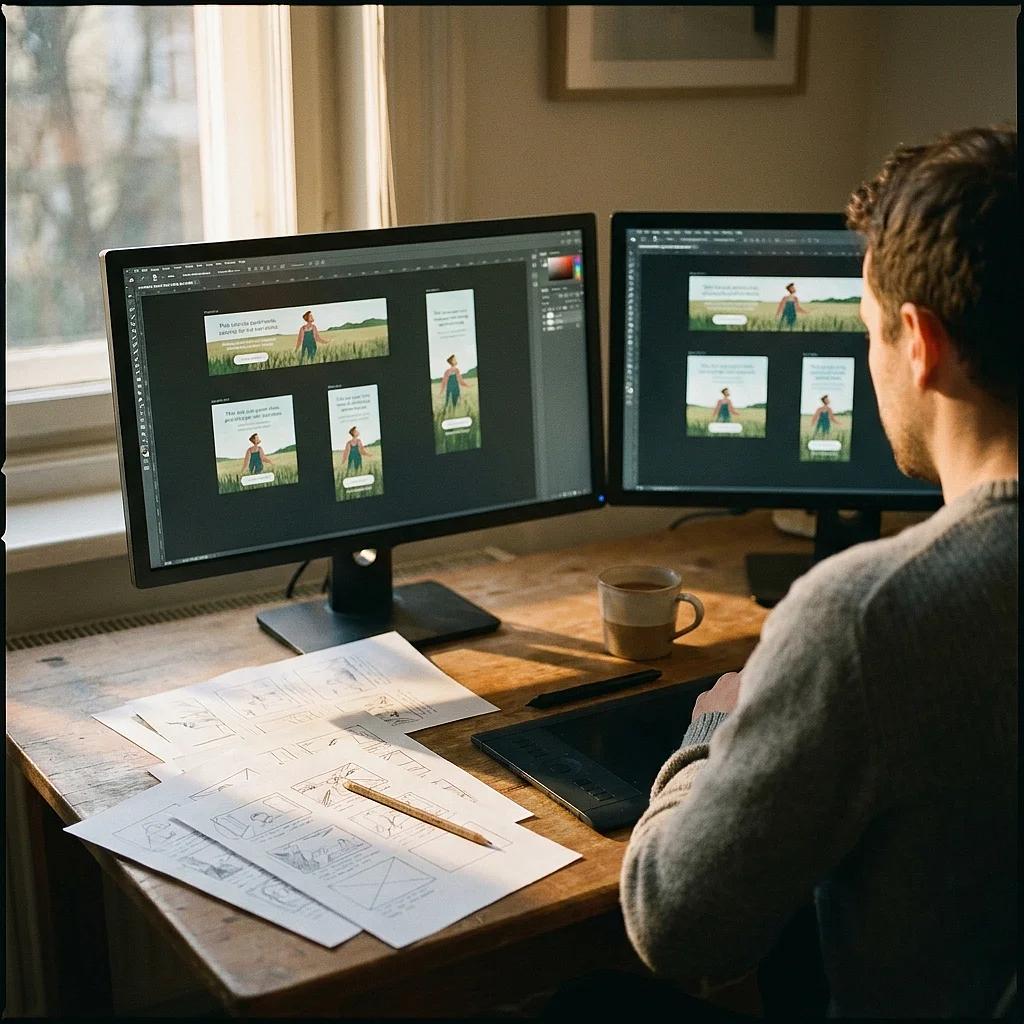
With Grok Imagine Image 2.0, another image model is available that goes beyond simple illustrations. According to the report at hand, it produces, among other things, advertising materials, infographics and storyboards and can convert existing images into other formats. At the same time, the model is said to leave a stale aftertaste: doubts about safety and the legal situation remain.
For companies that regularly set up landing pages, campaigns or product pages, precisely this combination is typical. The tools get better faster than operational rules can grow. Anyone who decouples the two runs into problems – either blocked projects or assets whose origin no one can prove anymore.
Where the benefit lies in everyday web work
Three of the mentioned use cases directly affect the everyday work of web teams.
- Advertising materials: Campaigns need many variants of the same motif. A model that delivers suggestions in series shortens above all the phase in which nothing has been decided yet.
- Infographics: Explanatory graphics in projects often fail not because of the design, but because no one has time for a first draft. A generator can deliver this draft – the content review remains the task of humans.
- Storyboards: For video sequences, onboarding flows or animations on a homepage, rough image sequences are a good means of coordination before production budget flows.
Particularly relevant is the possibility of bringing images into other sizes. Today, a motif has to work as a wide header image, as a square tile in the social feed and as a narrow element on the smartphone. Until now, this has meant either manual rework or hard crops in which the image composition is lost. Automatic resizing shifts this effort forward into the generation step.
Why the doubts are not just a side issue
The report names safety doubts without resolving them in detail. For practice, that is enough as a signal: an image model is not a neutral tool, but a component with its own risks. Two of them directly affect companies.
Rights and origin. With a generated image, without documentation it is later no longer recognisable with which tool, which prompt and under which terms of use it was created. Anyone who uses a motif on a product page for years should be able to record this information.
Content control. Models that restrict little also produce content that should not stand next to a brand. This is not a technical but an organisational problem: it needs an instance that approves before publication.
Guidelines instead of bans
A general ban on AI images can hardly be sustained in practice because the functions are built into more and more tools. A concise, binding guideline is more sensible. It can cover the following points:
- Name approved tools. Which services may be used for which purposes – and which explicitly may not?
- Grade areas of use. Internal drafts, storyboards and moodboards are less critical than images that permanently stand on a customer page or run in paid campaigns.
- Document origin. Tool, date and prompt belong as metadata in the media management, not in a separate table that no one maintains.
- Define taboo zones. No generated depictions of real persons, no invented product representations, no figures in infographics without a verified source.
- Clarify approval. A named role checks before publication. Without this step, all other rules do not take effect.
What that means technically
Image volumes grow quickly with generative tools. If a motif exists in five formats and several variants are tested per campaign, dozens of files arise from one idea. A content management system whose media management only knows folders becomes confusing as a result.
In TYPO3 projects – TYPO3 is an open-source content management system that is widespread among mid-sized companies – this can be addressed with built-in means. Custom metadata fields for origin and approval status, consistent tagging and the existing image variant functions keep the collection organised. It is important to establish this structure before the first hundred generated files lie in the system.
Likewise, automatic resizing does not replace technical image optimisation. Formats such as WebP or AVIF, sensible image sizes for different end devices and alternative texts for accessibility remain implementation tasks. A generator delivers motifs, not a delivered page.
Assessment
In web projects, generative image tools above all shift the early phases: drafts, variants and coordination material are created faster and more cheaply. The review and approval effort does not disappear as a result, it shifts – from production to control. Anyone who now determines which tools are permitted, how origin is documented and who approves can use the speed gains without bringing legal legacies into the media library.


