
New AI models now appear almost weekly. In companies, the discussion is therefore shifting away from the question of which model delivers the best answers towards a more sober one: where is the data actually processed, and under what legal and technical framework does this happen? For organisations with personal or business-critical data, this becomes the decisive selection criterion.
Two current specialist articles examine the same development from different directions. One takes a look at the legally secure hosting of AI agents, i.e. applications that work through tasks independently in several steps. The other shows that smaller tasks can already be handled today with locally installed models – entirely without the cloud. Together they produce a picture: the US cloud is long since no longer the only option.
The operational question decides the project
In many projects, the operational question is asked too late. A prototype is created with any API access, works convincingly – and then fails at the internal review because it is unclear which content leaves the company's area of responsibility. This is particularly delicate with agents, because they do not merely process individual inputs but can access documents, databases or emails in the course of their work steps. As a result, the volume of transmitted data often grows faster than the original approval intended.
From the perspective of the GDPR, three points are particularly relevant: the place of processing, the legal basis for a transfer to third countries and the question of whether and for how long inputs are stored or reused for training purposes. These points are contractual and architectural questions, not model questions. They can be clarified before the first line of code is written.
Path one: hosting in Europe
The first practicable path is the operation of models and agents with providers that process within the EU and contractually guarantee this. The advantage lies in scalability: computing power is purchased as needed, models are maintained and updated, and your own team does not have to operate any GPU infrastructure. For applications with fluctuating load or many simultaneous users, this remains the obvious variant.
What is decisive here is care in selection. Among other things, the actual location of the data centres, possible subcontracting relationships, the logging of requests and the question of whether inputs are excluded from training must be checked. A European company headquarters alone says nothing about the processing chain. Equally important is the technical side: separate environments for testing and production, a well-thought-out permissions concept and the ability to log requests and responses traceably without storing more personal data than necessary.
Path two: operating models locally
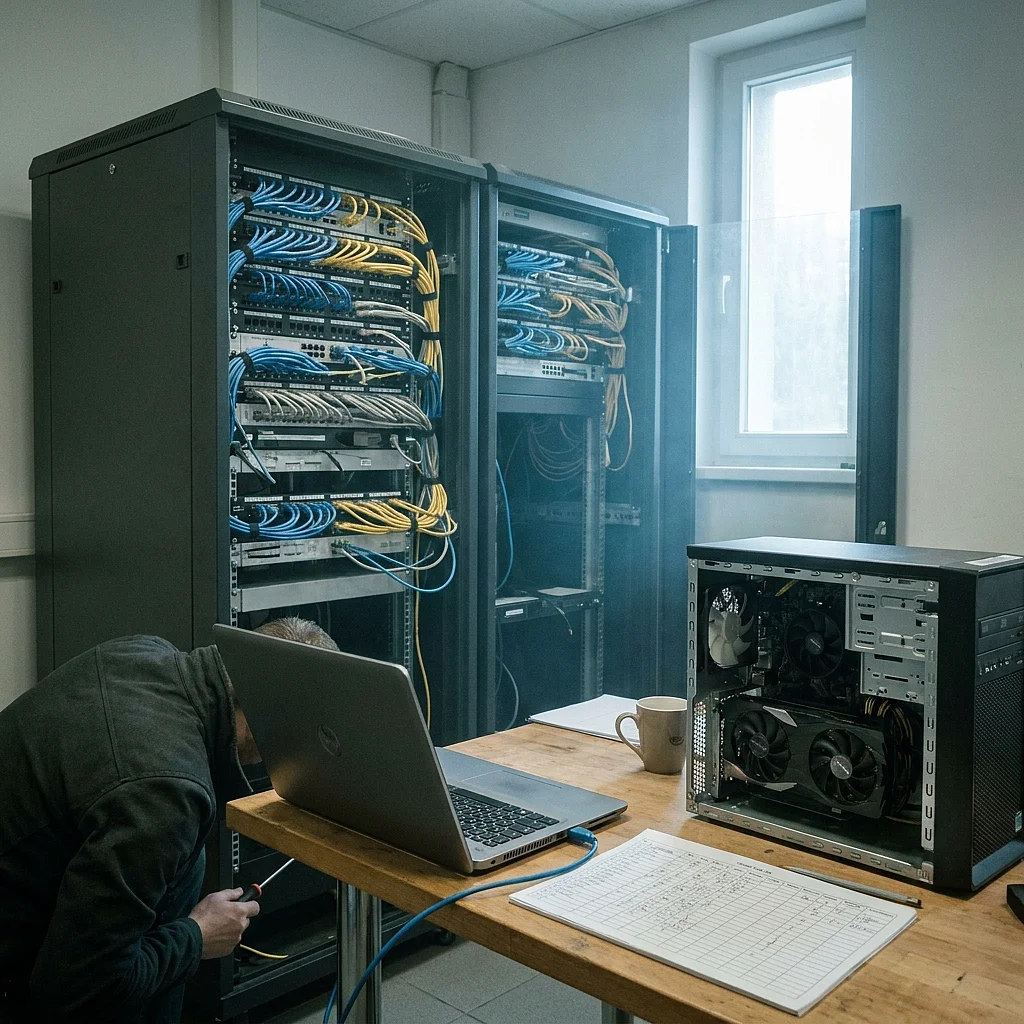
The second path leaves the cloud entirely. A mature tool landscape now exists for locally executed models: Ollama, LM Studio, Jan and Osaurus are mentioned, for example – applications that run open models on your own computer or on company-owned hardware. The range extends from entry-level tools with a graphical interface to solutions for advanced users that can be integrated into their own workflows.
The appeal is obvious: what does not leave the computer does not have to be transmitted to a third country under data protection law either. For tasks such as summarising internal documents, rephrasing texts, simple classifications or first drafts, the quality of smaller models is sufficient in many cases. Added to this is independence from price and model changes by external providers.
One should remain realistic about the limits. Local models are generally smaller than the large cloud offerings and deliver weaker results on complex tasks. They require sufficient working memory and, where possible, a powerful graphics unit, and they create effort for updating and maintenance. The cited assessment that they are primarily suited to smaller tasks is therefore not a limitation in the fine print, but the heart of the matter.
Usually it is a mixture
In practice, the two paths do not stand opposite each other as alternatives. A division by data classes is often sensible: what is particularly in need of protection is processed locally or in your own European environment; for non-critical tasks with high quality requirements, a hosted model is used. The prerequisite for this is an architecture in which the model remains interchangeable – for example via your own intermediate layer that forwards requests to the appropriate destination depending on classification.
A few steps have proven themselves for getting started:
- Inventory data types and divide them into protection classes before tools are selected.
- Determine for each use case which response quality is really needed – not every task needs the largest model.
- Encapsulate the model connection via your own interface so that a change does not trigger a new development.
- For agents, keep access rights to data sources narrow and make every work step traceable.
- Test local variants early on real hardware in order to know response times and resource requirements.
What this means for projects
For web and software projects, this means: the question of the place of operation belongs in the requirements phase, not in acceptance. Anyone who designs model connections to be interchangeable from the outset can switch between European hosting and local operation without rebuilding the application.
And because the tool landscape continues to move quickly, this flexibility is currently more valuable than committing to a particular model.


