
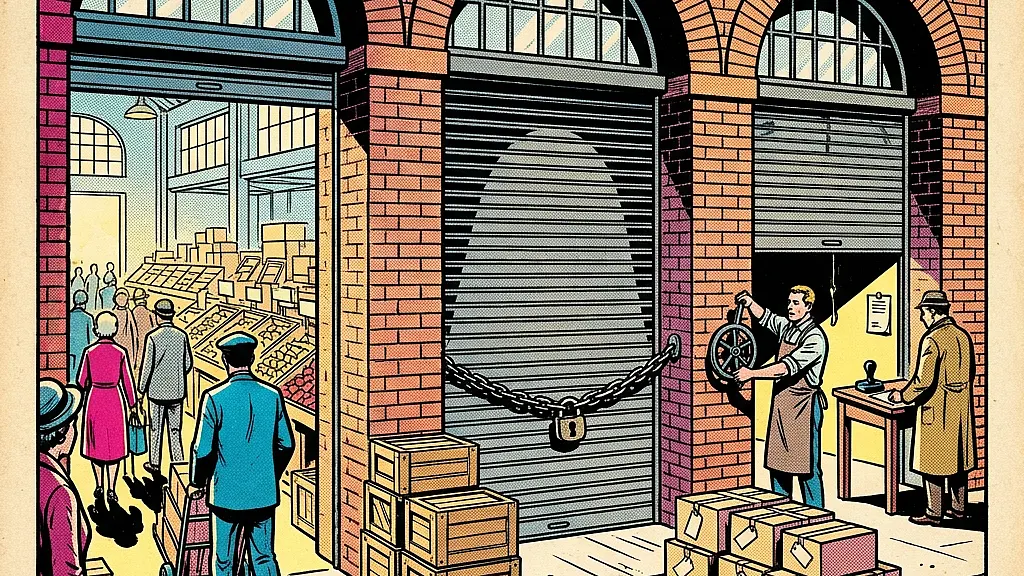
Amazon and Meta are in talks about readmitting Meta's AI shopping agent Muse to the Amazon online shop.Amazon had blocked access in September.According to reports, two points in particular are disputed: advertising revenue and control over which search results a customer gets to see.
Neither point is a marginal issue.Amazon's advertising business reaches a volume of 68.6 billion dollars a year.Anyone who inserts their own software layer between the user and the product list intervenes in precisely that part of the customer journey in which this business arises.
What a shopping agent actually does
An AI shopping agent is a program that independently searches for, compares and selects products on behalf of a person and, if in doubt, also orders them.Instead of clicking through categories and filters themselves, customers formulate an intent – and the software translates it into search queries, page views and shopping cart actions.
Technically, this changes the division of roles.The classic product detail page was built for humans: images, trust signals, cross-selling, ad placements.An agent reads only a fraction of this and decides on the basis of structured information such as price, availability, specifications and ratings.Anything conveyed exclusively visually is effectively excluded from the decision.
The share of such orders is no longer negligible: Muse accounts for a market share of 51 percent of agentic orders.That says little about the total volume of online retail, but a lot about how concentrated this new channel already is.
Why platforms regulate access
For Amazon, the block is economically understandable.A third-party agent that interprets search results, re-sorts them or presents a filtered selection deprives the platform of control over the order – and thus over sponsored placements.The dispute is therefore less about technology than about revenue sharing and control over presentation.
It is noteworthy that the block is followed by negotiations rather than a permanent blockade.This suggests that agentic access will in the medium term be regulated by contract rather than prevented: with defined interfaces, terms of use and presumably commercial conditions.For smaller retailers, this is a sign that access to product ranges will be negotiable in future – and therefore also shapeable.
What this means for own shops and websites
Operators of their own shops face a different starting position than a marketplace with billions in revenue from advertising.They do not earn from the placement business, but from sales.For them, an agent that can read and order correctly is initially an additional channel and not an attack on the business model.
What is decisive is whether their own platform is machine-readable enough.In practice, this above all means work on data and structures:
- Maintain product data cleanly: unique identifiers, consistent attributes, reliable price and availability information instead of implicit information in running text or images.
- Deliver structured data: machine-readable markup in the source code so that price, variant, delivery time and rating can be captured without interpretation.
- Provide interfaces: a documented API for catalogue, stock and order is more stable for agents than replicating click paths.
- Control access: clear rules on which automated accesses are permitted, with authentication, rate limiting and logging.
- Check processes behind the order: payment authorisation, returns, identity verification and customer communication have so far been designed for human interaction.
Content becomes the basis for decisions by machines
Something is shifting beyond pure shops as well.When software pre-selects offers, verifiable information counts more than tone.Comparison tables, technical data, limits of use, compatibilities and delivery conditions become hard ranking factors in a selection process that no human being goes through in full any more.
That does not devalue good content, but it changes its task.A text must serve two readers: the person seeking orientation and the system that compares.Content that achieves both is clearly structured, states facts explicitly and does not hide decision-relevant information in graphics or PDFs.
Keep an eye on dependency and concentration
The market share of more than half of all agentic orders at a single provider also reveals a risk.Anyone who ties their visibility to individual agents in future is repeating a familiar pattern: dependency on an intermediary whose rules and conditions can change – as the block in September illustrated.
A strategy that is not optimised for one provider but for general readability therefore makes sense: open formats, documented interfaces, clean data.These investments pay off regardless of which agent prevails – and incidentally improve search engine findability, data quality and internal processes.
Assessment
For web and software projects, the priority shifts from the surface to the data layer: what an agent cannot read in a structured way does not exist for it.Anyone already planning a relaunch, a PIM implementation or an interface modernisation should include machine readability and controlled API access as requirements now, instead of retrofitting them later.
And anyone who gains reach via platforms should be set up contractually and technically in such a way that a block by a single actor does not cost the entire channel.