
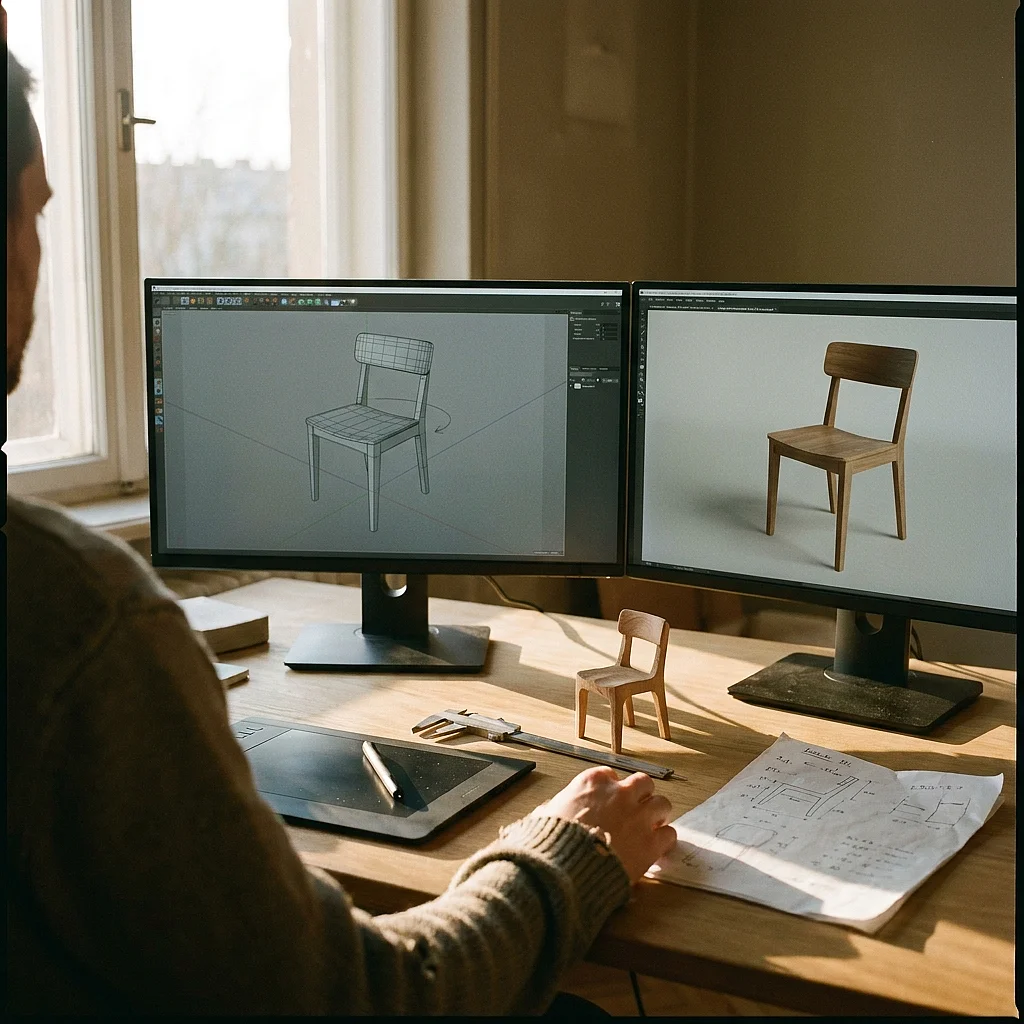
AI agents have reached text, code, images and audio in recent years. Now another discipline is following suit: three-dimensional models. Tools such as Meshy's 3D Agent promise to generate a finished object from a description in the chat – without CAD software, i.e. without a classic computer-aided design program, and without modelling skills.
For web and software projects, this sounds like an obvious relief. Product configurators, interactive landing pages, training applications or augmented reality views in online shops thrive on 3D content. In practice, precisely this content is often the bottleneck: it has to be drawn, modelled, textured and optimised, which ties up time and specialised staff.
Creation was never the bottleneck
The key observation, however, is this: creating a 3D model was never the actual problem. Libraries with ready-made assets have existed for years, modelling tools are available, service providers can be commissioned. The effort arises elsewhere – namely where a model is to be embedded in a concrete application and must thereby meet technical and content requirements.
This shifts the relevant question. It is not how quickly an agent outputs an object, but whether this object is usable in production operation. And this assessment is considerably less comfortable, because it cannot be answered in a demo.
What determines usability on the web
Anyone using 3D content in a website or a configurator should check a model against several criteria. The following points are not a statement about a specific tool, but the checklist that applies regardless of the creation method:
- Polygon count and file size: A model with very fine geometry looks good in the preview, but can make a page unusably slow on mobile devices.
- Topology: That is, the internal structure of the mesh. Clean, even surfaces are a prerequisite if an object is later to be animated, deformed or further processed in variants.
- Textures and materials: Are they supplied in formats that the web 3D library used understands? Do they behave plausibly under different lighting situations?
- Dimensional accuracy: In product presentations, it is crucial whether proportions and dimensions correspond to the real article. A visually convincing but incorrectly dimensioned model is a risk in sales.
- Post-editability: Can the result be exported to a standard format and corrected in existing tools – or is it effectively a black box?
- Legal situation: Usage rights to generated assets and the question of what a model was trained on must be clarified before going into production.
The difference between prototype and production
These criteria are not equally strict in every scenario. For an internal prototype, a mood image or a moodboard, a model that conveys the idea is enough. Such use cases benefit directly when an agent delivers in minutes what would otherwise take days – also because then the actual design can be discussed earlier instead of schedules.
The situation is different when a model becomes part of a product promise. In a configurator that shows customers what their ordered product will look like, the representation is not decorative but binding. Here it is not the speed of creation that decides, but the correspondence with the real master data.
A clear separation within the project is therefore sensible: where may generated material be used directly, where does it serve only as a starting point for a checked final version, and where is it excluded? This determination belongs in the project definition and not in the final phase shortly before launch.
What this means for the process
Anyone who wants to use generated 3D assets seriously needs less a new tool than a defined path from the result to delivery. This includes a specified exchange format, an optimisation stage for the web, a place where assets are versioned, and an instance that approves them.
The checking itself can also be partially automated. Thresholds for file size and polygon count, completeness checks for textures and an automatic load-time test in the delivery chain catch a large part of the typical problems before anyone has to look manually. The content assessment – does the object look like the product? – remains a human task, by contrast.
What is remarkable about the development is above all that a pattern repeats itself. As with text, image and code, AI drastically lowers the hurdle for creation, but changes little about the requirements for the end result. The effort does not disappear, it shifts – from production to selection, checking and integration.
Assessment
For web and software projects, this means: prompt-based 3D creation is a real gain in early phases in which variants are to become visible quickly, and it opens up access to 3D for teams without CAD expertise. However, its use only becomes reliable with defined quality criteria, an optimisation stage for the web and a clear approval.Those who plan these steps in as well gain speed; those who look only at generation merely shift the effort into troubleshooting after launch.


