
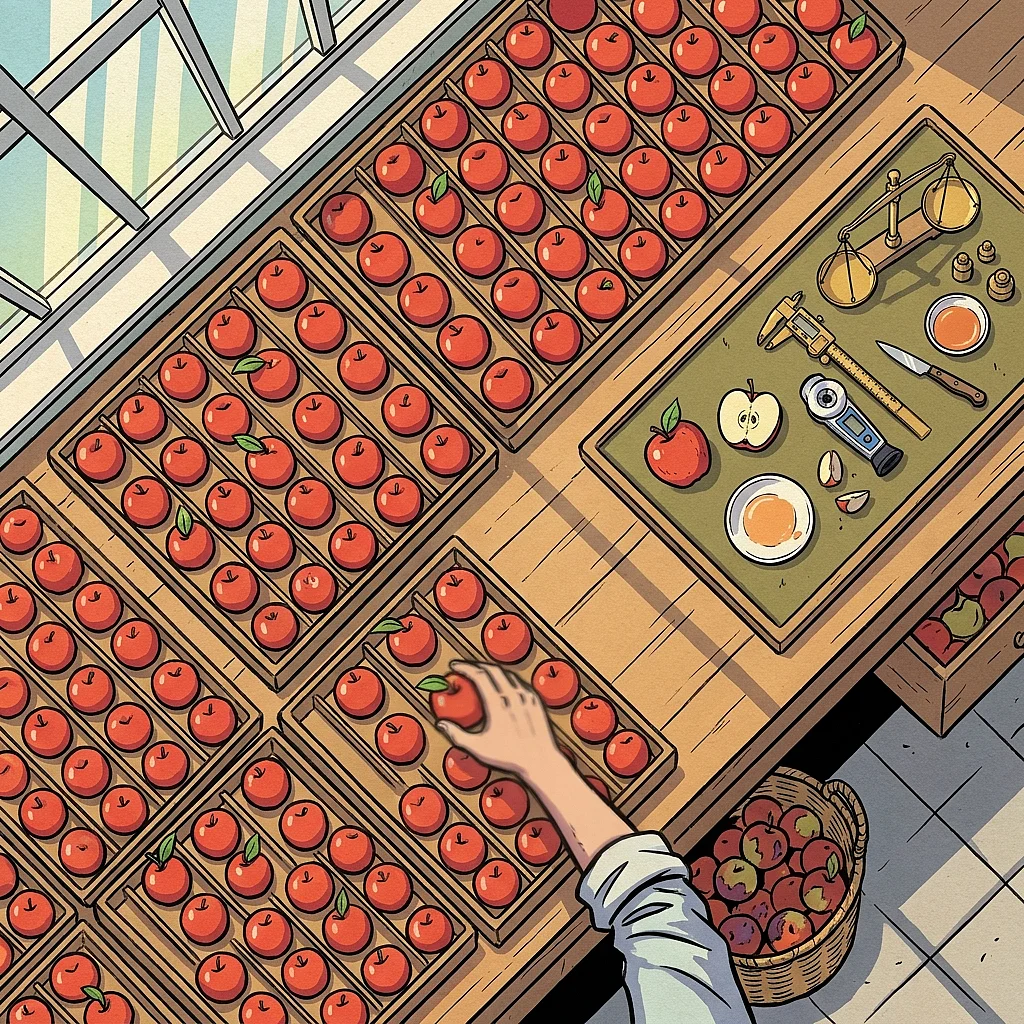
Generative tools have largely solved the quantity problem in design. Variants of a headline, alternative sentence structures, layout proposals in different formats – all of this is now produced in a short time and in large numbers. However, this gives rise to a new difficulty: it is not production that is the bottleneck, but the well-founded decision about which variant is the right one.
A current consideration under the heading Typographic Intelligence argues that classic design systems are no longer sufficient for this. Modern brand management needs systems that not only scale design but firmly embed expertise and human judgement in the creative process. This is less a design debate than a question of process architecture – and thus directly relevant for website, shop and product projects.
What design systems achieve – and what they do not
A design system is the documented collection of a brand's reusable building blocks: colours, spacings, font sizes, components such as buttons or teaser tiles, each with rules for their use. The benefit lies in consistency and speed. Anyone building a new landing page does not have to clarify fundamental questions again.
However, these systems are primarily designed for repeatability. They answer the question "How do I implement something we have already defined?" very well. They answer the question "Which of twelve plausible variants best carries the brand?" only to a limited extent. As long as variants were expensive, this hardly stood out: there was simply little choice. As soon as variants become cheap, the effort shifts to evaluation, justification and approval.
Why typography in particular is the touchstone
On the web, typography is not a decorative detail but infrastructure. It determines how quickly content is grasped, how credible a brand appears and whether texts are still legible on small displays. At the same time, typographic decisions are subtle: letter spacing, line spacing, font size in relation to line length, contrast between heading and body text.
It is precisely such fine details that can be generated automatically in large numbers, but can only be evaluated with experience. A proposal can be formally compliant with the rules and still be wrong – because it misses the brand's tone, because it collapses at real content length or because it becomes unusable when enlarged by users. Accessibility and brand impact depend on the same levers here.
From a variant problem to a decision problem
When output is no longer the bottleneck, the quality of a project is determined by the quality of its decision-making paths. Three points deserve particular attention:
- Criteria before variants. Those who select first and justify afterwards decide by taste. It is more sensible to define in advance what makes a good solution recognisable – for example legibility at defined line lengths, contrast requirements, behaviour with long product names.
- Clarify responsibilities. It must be named who is responsible for a typographic or design decision and who merely comments on it. Otherwise, many opinions produce a compromise that benefits no one.
- Document decisions. A short note on why a variant was chosen prevents the same discussion from being held again in the next sprint. The design system thus becomes a knowledge store rather than a component catalogue.
Embedding expertise in the process instead of checking it afterwards
The key thought is: judgement does not belong at the end of the chain but in the middle. If expertise only appears at acceptance, expensive correction loops arise. If, by contrast, it is anchored early in the form of explicit rules, review steps and decision templates, it filters out unsuitable proposals before they tie up effort.
In practice, this means treating generative tools as suppliers. They deliver material that must pass a defined entry test before it is processed further. Much of this can be safeguarded technically – contrast checks, component tests, automated checks on spacings and font sizes. The rest remains a professional assessment that people make.
Concrete starting points for ongoing projects
- Check whether your design system only describes components or also contains justifications. Missing justifications are the most common cause of inconsistency in growing teams.
- Define minimum typographic requirements as verifiable rules, not as a matter of taste – and automate what can be automated.
- Test drafts with realistic content: real product names, long headings, multilingual texts. Variants that only work with placeholder text are not a solution.
- Determine at which points in the workflow a decision is bindingly made – and stick to it, even if further variants would become available later.
Assessment
For web and software projects, the lever thus shifts: time and budget will in future depend less on the question of how quickly drafts are created and more on how clearly a team can evaluate and discard variants. Design systems remain important but must be supplemented by documented criteria, clear responsibilities and automated checks.
Whoever builds this decision-making level now uses generative tools as an accelerator – whoever omits it produces mainly more material that no one ultimately takes responsibility for.


