
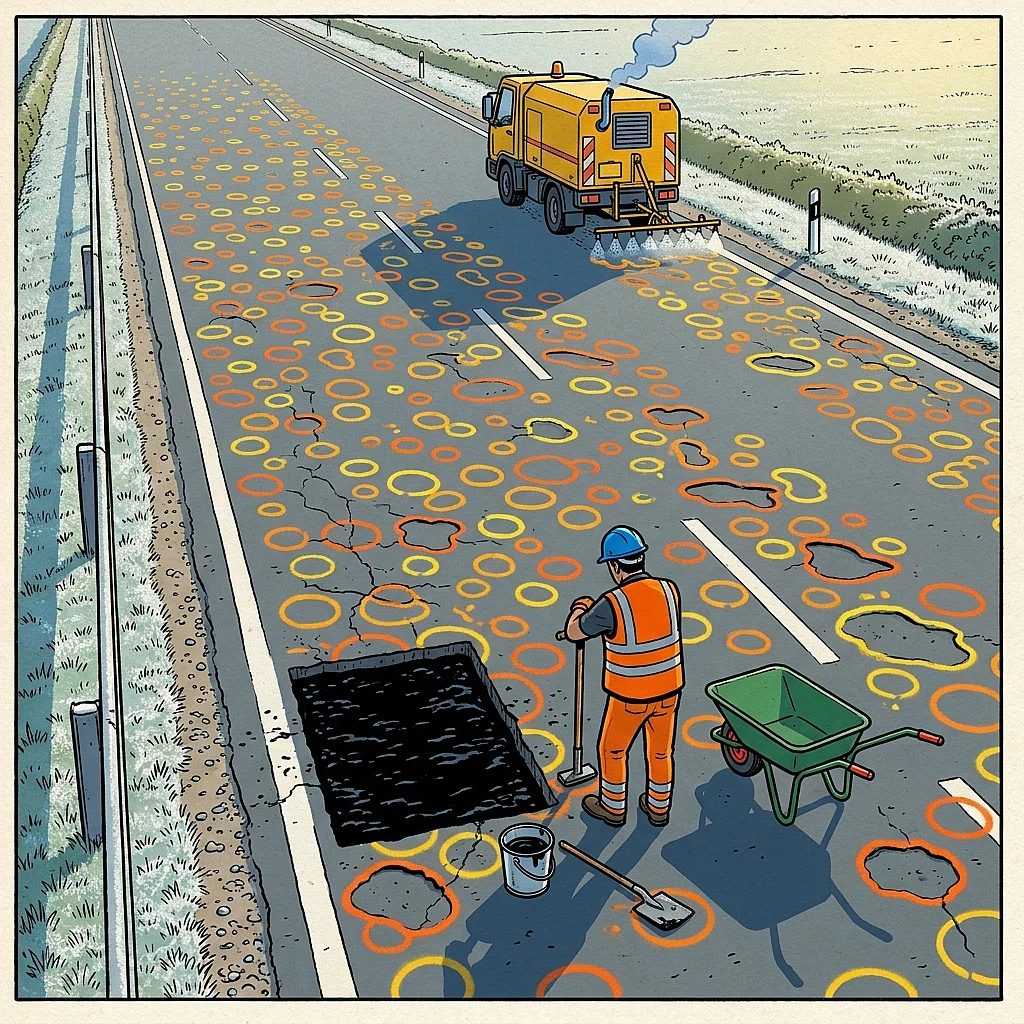
A major institution has its codebase reviewed by AI models – and is then faced with a list that its own team cannot work through.Several specialist media outlets report unanimously that Bank of America has engaged around 1,000 external contractors to close security vulnerabilities that had previously been found with AI support.Among others, the model Mythos is named, which one of the reports attributes to Anthropic.
In this context, the number is the real signal.It was not the analysis that was the bottleneck, but the implementation.Finding vulnerabilities has been massively accelerated by AI, fixing them has not to the same extent.
Analysis scales, remediation does not
Static code analysis has existed for decades.What is new is that language models grasp connections across file boundaries, read domain logic alongside, and also report patterns that classic rule sets overlook.Accordingly, the lists of findings become longer.
Patching, by contrast, remains classic development work: understand, change, test, roll out, document.Every intervention in grown code carries a regression risk, i.e. the danger that a correction elsewhere breaks functionality.This is precisely the part that cannot simply be shortened by more computing power.
The fact that a company of this size buys in external capacity in the four-digit range suggests that the volume of findings clearly exceeded what internal teams could handle alongside ongoing operations.
The business case lies behind the effort
One of the reports points out that the bank expects considerable savings potential after completion of the patch work.Details on this are not reliably public, which is why it is worth looking at the logic behind it rather than at figures.
Those who know about vulnerabilities must address them – also in terms of liability.Unknown risks are convenient, but expensive when they are exploited.A one-off clean-up wave is an investment block; the lasting benefit only arises when a process exists afterwards that works through new findings continuously and in small quantities.
What this means for mid-sized web and CMS systems
Most companies do not have 1,000 external developers available.But they have the same starting position: a platform that has grown over years, extensions of various origins, dependencies that no one fully oversees any more.
Anyone who starts an AI-supported code review in this situation should know beforehand how the result will be handled.Otherwise a document is created that generates pressure to act without creating the ability to act.
Prioritisation is the decisive step
Not every finding is a risk.What matters is whether a vulnerability is reachable at all in the specific system – from outside, without login, in a productive path.A simple sequence has proven effective:
- Reachability: Is the affected code reachable via the open internet or only active in internal tools?
- Data relevance: Are personal data, payment data or access credentials affected?
- Exploitability: Does it require a chain of unusual preconditions or is a manipulated request enough?
- Effort of correction: Point fix, dependency update or rebuild of a module?
Only the combination of these points produces a sequence that can be justified to management and budget owners.
Factor in false positives
AI-supported analysis also delivers indications that prove to be non-critical on closer inspection.This is not an argument against the method, but an argument for an intermediate step: every finding needs a specialist assessment by humans before it goes onto the implementation list.
Without this filter, two things happen.Teams lose time on corrections without a security gain, and trust in future reports declines.Both are more expensive than the assessment itself.
A robust workflow for practice
For grown web and CMS landscapes, a staged approach has proven effective:
- Stocktaking: Which systems, extensions and libraries are in use, in which versions?
- Analysis: Automated testing, supplemented by AI-supported review of in-house custom development.
- Triage: Assessment of each finding according to reachability, data relevance and effort.
- Immediate measures: What can be secured without a release cycle, for example via access restrictions or configuration.
- Processing in waves: Fixed capacity per sprint instead of a one-off feat of strength.
- Safeguarding: Automated tests and recurring review runs so that findings do not return.
The sixth point is the one most frequently cut and is the most important.A one-off clean-up only lasts if it is anchored in the pipeline – that is, in the automated steps between commit and deployment.
Using external capacity sensibly
In the case of Bank of America, buying in external development capacity is a reaction to volume pressure.For smaller organisations, the principle applies in modified form: external support pays off where recurring, clearly describable work arises – dependency updates, adaptation of outdated interfaces, catching up on security configurations.
Interventions intensive in context and domain logic, by contrast, belong with the people who know the system.
This separation determines whether additional capacity relieves the burden or creates additional coordination effort.
Classification
For web and software projects, the bottleneck shifts: AI-supported review is available and inexpensive, while remediation remains manual work requiring budget and time. Anyone commissioning a code review should plan the implementation capacity for the findings at the same time, otherwise a documented risk arises without a solution. It therefore makes sense to treat analysis, prioritisation and dedicated processing capacity as a single undertaking from the outset – and to integrate the results permanently into the development process instead of a one-off action.


