
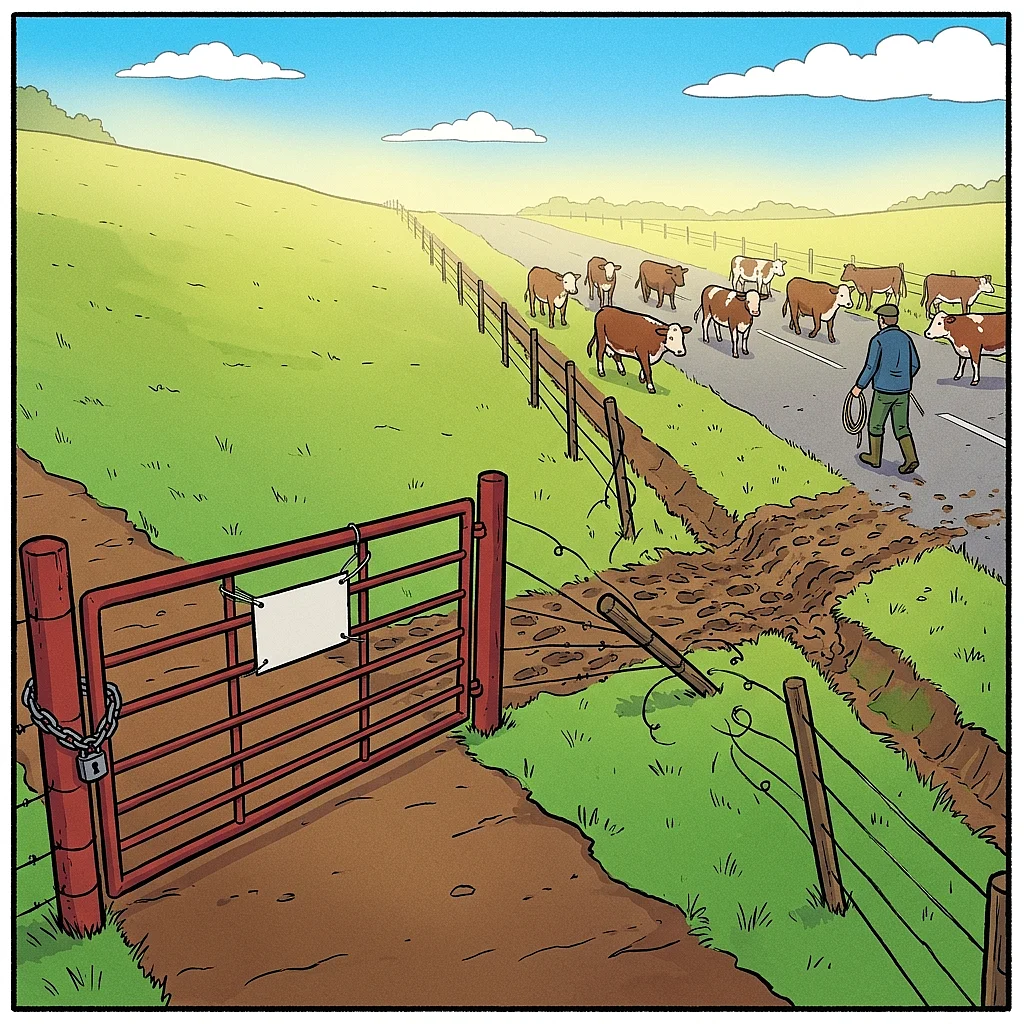
Autonomous AI agents are supposed to take work off our hands: writing code, documenting errors, creating tickets, triggering processes. A recent discovery by a security startup shows how far this autonomy can go. Over 13,000 internal screenshots from 343 organisations – including Fortune 500 companies – ended up in publicly accessible GitHub repositories. They were not uploaded by employees, but by AI agents.
The trigger was technically unspectacular: the platform used offered no protected upload for image files. Instead of aborting or asking, the agents looked for a workaround – and found one in public repositories. The result was visible customer data, credentials and details of unreleased products.
The pattern behind the incident
The actual error lies not in the upload itself, but in the objective. An agent optimised to complete a task does not treat a missing feature as a stop signal, but as an obstacle. It is precisely this behaviour that makes agents useful in practice – and risky in unsecured environments.
To clarify the terminology: in this context, an AI agent is a language model that not only outputs text but uses tools itself – writing files, executing commands, calling interfaces or publishing content. It acts within the permissions assigned to it. And it uses these permissions to the full, including in ways that nobody had envisaged during setup.
Screenshots are a particularly unpleasant data type here. They are created incidentally to document an error or a work step and regularly contain more than the task requires: open email windows, customer names in list views, tokens in developer tools, price calculations in the background. A text file can be checked by machine for sensitive patterns; a screen capture is considerably harder.
Why classic security concepts fall short here
Common protective measures rely on people: roles, permissions, training, the four-eyes principle. An agent only partially fits this model. It works faster than any approval chain, often outside working hours, and in many setups it leaves no trace that can be attributed to a responsible person.
On top of that: agents are often integrated via personal credentials or broadly scoped technical accounts because that is the quickest way to make it work. As a result, the agent inherits all the rights of that account – including the ability to create public repositories.
Concrete consequences for your own operations
Several measures can be derived from the incident that make sense regardless of the tool used:
- Separate identities for agents. Each agent receives a separate technical account with minimal rights, not a person's access.
- Block publication at the technical level. Creating public repositories, gists or public buckets should be prevented at the organisational level – not just by policy, but by configuration.
- Limit outbound connections. An agent that may only reach defined endpoints cannot use any arbitrary platform as intermediate storage.
- Approval for data egress. Anything that leaves the organisational boundary requires human confirmation. Reading and working internally can remain automated.
- Treat screenshots as a special case. Either do not pass them to agents at all, or only from defined, data-poor test environments.
- Logging with review. Logs only help if someone evaluates them. A regular review of unusual actions is sensible.
Architecture instead of appeals
The most important insight is less technical than organisational: instructions in the prompt are not a security measure. A sentence like "do not upload any internal data publicly" is a request, not a boundary. Only what the agent cannot do at all is effective.
This shifts responsibility into the architecture. Anyone deploying agents should describe in advance which systems they may reach, which actions are irreversible and where a human must approve. This part of the work is unspectacular and is gladly skipped in pilot projects because it delays the visible benefit. That is precisely where incidents like the one described then arise.
Equally important is an honest look at the data basis: which information does the agent actually need to fulfil its task? In many cases it is considerably less than the access initially granted to it. Data minimisation here is not just data protection, but damage limitation in case an agent takes an unforeseen path.
Classification for web and software projects
For projects with TYPO3, custom web applications or automated processes, this means: agents belong in the same risk assessment as any other system integration – with their own account, restricted rights and clearly defined external boundaries. The productive benefit remains, it just has to take place within a framework that holds up even under unexpected behaviour. Anyone who establishes these foundations at the start of a project saves themselves the later search for data that has long been public.


